Mountain Magazine
← Medical Flights to Sierra Madre

Survival at Sierra Madre

By Kent Gunnufson  ·  July 2, 2020

The Arvada Rotary Club held a number of eye-glass and medical clinics in Guachochi, a 8,000-foot-high community in Mexico. I went along and made a documentary titled Medical Flights to Sierra Madre. Each trip had its own personality and lots of adventure. One winter I had a lifetime experience — and it made a really awesome back-story to my documentary. It happened just as written. Don't skim; the text is carefully crafted for a special ending.


The Night

My body shook from the cold, my hands and knees were numb. I could barely feel my fingers raking a half-inch layer of pine needles into a bed to insulate against the cold ground. I started building a partial lean-to, but wasn't able to break off pine boughs needed to complete the top cover. It was my desperate effort to survive a freezing winter night in the wilderness of Central Mexico's Sierra Madre. I was alone at 8,000 feet and lost in total darkness.

The starry night barely showed through the forest's mantel. Even venturing a few feet in search of shelter materials forced me to feel my way back to my nest. The night was sucking my warmth and life energy like a black hole. My turtleneck shirt and webbed photo vest were inadequate for such temperatures and I had not eaten since breakfast. My mouth and tongue were dry and my lips were cracked from dehydration. I was exhausted from the long day's journey. Thoughts of lying down and going to sleep were at their final stage of seducing me. There were a series of events that brought me to this point.

Over the last decade, Jack Emery and his wife Peg have made a significant impact on Guachochi, Mexico. They and other Rotarians have brought free eyeglasses, medical care and significant infrastructure additions to that community. To be successful, each trip requires a lot of work throughout the year. They fly or drive in 9 to 16 people to Guachochi twice a year. All trips are meticulously planned. Each volunteer pays his or her own expenses for the privilege of working two long days.

The agenda is balanced by socializing with the locals at night. Because the days are so hectic with work, the next day's plans are discussed between songs and toasts. That typically leaves a short night's sleep, but the team keeps going from an unexplained source of energy.

Flying in to Guachochi, Mexico
Bernie Roland landing at Guachochi

Guachochi

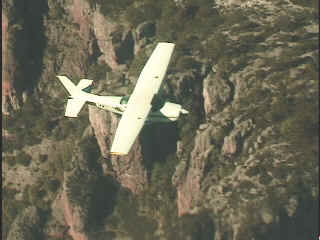
An old college friend wanted to know if I was interested in flying to Guachochi, Mexico to document the humanitarian efforts by the Arvada Colorado Rotary Club. He briefed me about this small secluded community setting at 8,000 feet among the Sierra Madre peaks adjacent to the Copper Canyon. They were flying small private planes loaded with medical supplies and landing on a short dirt-landing strip. The only mandatory issue was leaving early from Arvada so we land while there's still light. I eagerly signed on.

Thinking back, I can recall Jack Emery's chuckle as he told me: "You know, it's strange how this works. Those that come down to Guachochi find something special." The glimmer in his eyes told me he was saying more than his words. Later I would realize how prolific his statement really was.

Walking through town was a constant reminder of the area's third world status. An old dilapidated flatbed-truck was on the street and jacked up for repair with an automobile battery. Block after block inside the town displayed structures crudely made of adobe or masonry. We reached the large community center with its two-foot-thick, white, stone walls. Though it isn't heated, the wall mass retains heat and keeps temperatures somewhat warmer inside during the night.

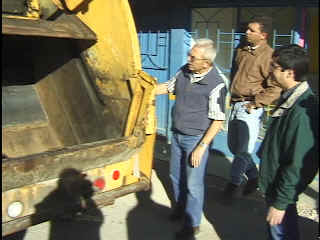
Jack Emery instructs Alfredo on the Rotary Club's new gift
Jack Emery instructs Alfredo on the Rotary Club's new gift to Guachochi
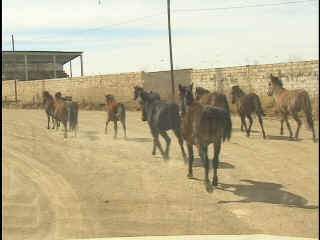
Wild horses ran down the street in front of our clinic

The Clinic

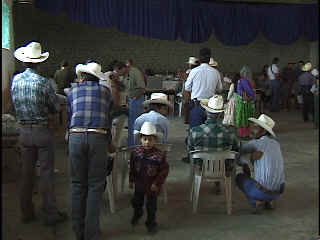
As we reached the clinic hundreds of Mexican nationals and indigenous Indians were lined up waiting for treatment. They were patiently waiting for the clinic to open. Groups began to form. One line-up of male Mexicans with large white hats resembled a scene out of a Clint Eastwood movie. Colorful lavenders, greens, reds and deep blue mixed in lively patterns distinguished the Indian women. The children were very quiet until some of the Rotary team prodded them out of their shells. Fascinating how the children enjoyed getting several Disney stickers placed on their faces and interacting with our team. Even teenage girls were mischievously running around the clinic showing off their new ornaments.

Though the Indians wore a variety of clothing ranging from Nike to local Mexican dress, some Indians appeared never to have been introduced to western clothing. One had a coarsely-woven white-wrap about his waist. He carried a horse's collar around his neck for a lack of a place to store it at the clinic. I saw an Indian dressed in a simple loin cloth, but sensed a powerful man looking through my facade. I stood in awe as if I were standing before a time window and feared being pulled into a different reality.

The children found even more interest with what was going on under the shade tree. Doctor Friedman had started oral surgery and eventually pulled 26 teeth that day.

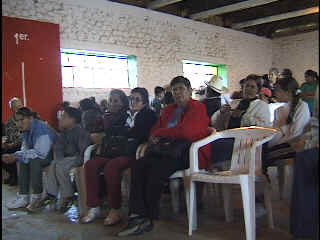
Hundreds patiently wait for free medical aid
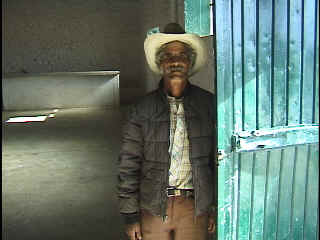
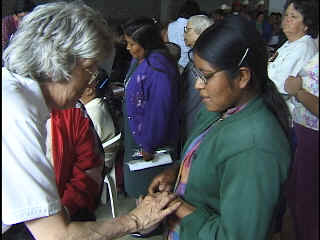
A volunteer at the clinic
A volunteer at the clinic — indicative of community support
Waiting for medical aid in Guachochi

Melina

Time flew by and it was already past noon then I heard my stomach growl in anticipation. Then Peg motioned me over. "Kent, this is the patient you've been waiting for. Melina is a 13-year-old Indian girl with 11 diopters of correction. She's going to see a big difference when she gets her glasses." I wanted to talk with Melina and her father, Pedro, but I couldn't speak their language. So, our interpreter, Alfredo, made arrangements for me to go back and videotape Melina in their home.

Alfredo told me "I know where the village is, an hour walk from here. It is along the highway. What do you want to do?" "Highway, that sounds good. Maybe I can make an appointment and meet them there for an interview." Peg jumped in: "Kent, you know that you may never find them if you don't go with them right now! You said you wanted to document one of our patients in more depth and this is just what you were looking for. You need to just go for it!"

A lack of communication skills prevented any chance of an invitation to spend the night. My crude form of sign language was equally unsuccessful for getting directions to the highway supposedly nearby. Eventually, Pedro's son came over and pointed back up the mountain I had just come down. Reluctantly, I accepted the reality and slowly headed up. This road was supposed to be right next to the village, but wasn't. My alternative escapes from here had evaporated and now I was facing the reality... would I survive?

Peg fits Melina with temporary glasses
Peg fits Melina with temporary glasses until a special 11-diopter correction can be made
Alfredo translates my request to follow Melina's family home

The Journey

The hour walk was intimidating. Being after 1 PM, this trip would probably take the rest of the afternoon. I left my down jacket to cut weight and hiking the trail would generate considerable heat. My Indian family headed out the door and I followed as I was putting on my Banana Republic photo vest. I quickly checked my pockets for the important essentials: camera, extra battery, and extra tape. They had already left and now I had to jog to catch up.

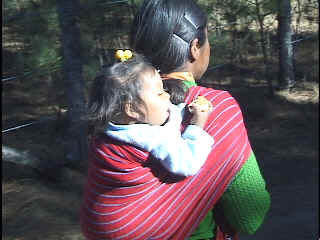
The mother with her one-year-old papoose strapped to her back joined Pedro and Melina heading down the street at a speedy clip. These were Tarahumara Indians who are renowned for their cross-country running ability. They run everywhere in the Copper Canyon region and running is their only means of transportation. Though fast, their pace had adapted, but still tested my abilities. Pedro led nearly twenty feet in front of his family. I followed up at the end.

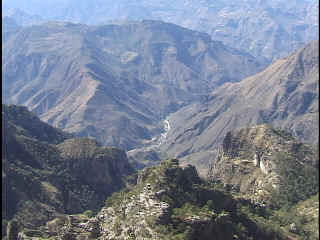
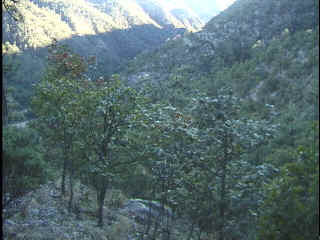
The town road sloped uphill to the graveyard, and homes became less frequent. Outside town the road narrowed and slightly started downhill. We then started following a well-defined path that cut through some fenced properties and continued down into a deep canyon. Then the trail became radically steeper and less traveled. This region was abundant with deep canyons that eventually contribute to the Copper Canyon, which is deeper than the Grand Canyon, but has more vegetation and trees.

The sun had already set in the valley bottom. Even if I climbed out of this first canyon, there wouldn't be enough time to make it back to Guachochi. The realities sucked out what energy I had. For any chance, an attitude change was imperative. No time to be tired, no time to be hopeless. It was time to get going. Methodically, I labored back up the trail pacing myself to make the impossible possible.

Melina's family lived near the Copper Canyon
Melina's family lived at the bottom of a canyon near the Copper Canyon
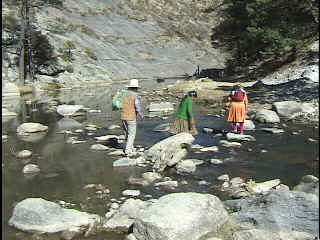
Melina and her family crossing the river
Melina and her family crossing the river at the valley bottom
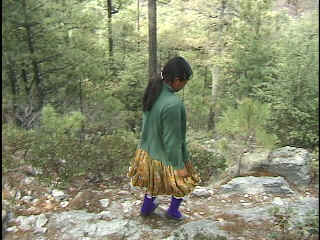
Melina on the trail
Melina on the trail — the slope is steeper than this perspective appears

The Canyon

I shot video on the move, but often had to stop for shooting. Then I had to run to catch up. I was gasping for breath and felt my heart pounding. I was pushing myself, but thought I could handle it for the next half-hour. Finally, we reached the valley bottom where there was a rock path to cross the river. My legs were burning, and the short distance across the bottom hadn't offered any significant relief. Now Pedro was starting up the far canyon side before I had even started to cross.

The path was steep and this type of hiking usually calls for half steps. I was being pressed into taking fuller strides than I would normally take. My energy was waning, my lungs burned and heart pounded hard. I had to stop several times up the canyon wall. Half-way up, I spotted Pedro. He had come back for me. As I approached Pedro, I was rewarded with a grin. I realized my first insight to his personality was this manifestation of him being the better man.

Then we continued up a hundred yards where we caught up with the rest of his family resting. Humbled, I quickly sat down to squash any ideas of heading out before I had a chance to rest. Pedro offered me two foam-filled chocolate cookies. In rough Spanish I said: "Gracias." After five minutes, the family got up and readied themselves to continue the ascent. However, the pace was slower than before. It seemed as if we climbed switchbacks forever. Eventually we reached the top.

At this point, pacing was more than a technique, it was a critical strategy for survival. Instead of taking large strides, I took smaller strides — like using a lower gear in a car for climbing hills. My steps were a fourth of my normal stride but paced so I could climb the steep trail without stopping. Fourth of a step, fourth of a step; one after another in a slow, but steady pace. Though the climb seemed like an eternity, it probably took me about forty minutes to reach the valley top.

As I stepped over the top ridge, I was greeted by the sun. A smart choice taking baby steps left me enough energy to continue on, instead of being extremely exhausted. But there were still three miles of hilly terrain before reaching the last deep gorge before Guachochi. The clock was running and I had less than an hour of sunlight. I headed down the trail, and everything looked different. I had hoped that my backward glances and trail markers would guide me back.

After a half mile, I noticed Pedro's footprints in areas comprised of soil, and invisible on the rocky areas. At times there were no tracks. I had to follow various forks a hundred feet or more before locating prints or making a guess as to which path to follow. Tracking takes time and I felt angry about wasting precious minutes. The sun edged towards the horizon and heightened my concerns over having enough light for the last gorge to cross.

Melina takes her turn carrying her little sister
Shadows were already filling the valleys
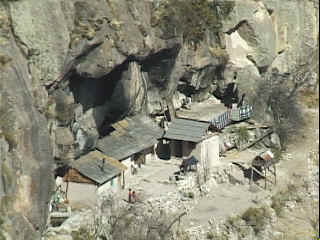
Cliff dwellings near Copper Canyon

Pedro's Home

We went from road to trail to road to trail several times. The trails were over more rock now and were barely distinguishable. My attention was on how to get back as it was getting late. I would look back several times and at the transitions to build a reference. I even placed stones and rocks along the road for markers to guide my return home. The distance we'd traveled since the initial gorge had to be at least three miles.

Deep down I was beginning to feel I would not be able to make it back. Maybe I should turn back. However, I had an alternative plan. Alberto said he knew where Pedro's village was along the highway. When it gets late and I haven't shown up, Peg and Jack will miss me and come looking for me. I could hitchhike back. My other choice was to turn back now, but I wouldn't be able to get the crucial images of Melina and her home. I was too tired to think rationally and just kept forging forward.

Then we rounded a crest. Just in front of us was a spectacular gorge. Pedro unleashed a store of energy to streak down a trail dropping into the deep canyon. At first, I kept up by taking large steps, each step flirted with disaster due to my wobbly tired legs. I slowed. Falling downhill with a three-chip digital camera could easily destroy it. Pedro and family pulled ahead and I lost sight of them among the trees.

My lips were cracking and the front part of my mouth was dry. I'd moisten my tongue in the back part of my mouth and then relay that moisture up to the front. What I would have given for a glass of water! My saliva reservoir ran out and then the end of my tongue dried out and felt like a piece of wood. Emotionally I felt a wrenching desperation and concern for not being able to swallow. I hadn't eaten since breakfast, but strangely I wasn't focused on food. My body's cravings had prioritized the essentials for survival.

The clock had run out. The big decision needed to be made. My choices were to spend what precious time I had for walking or should I build a shelter. Common survival skills dictates seeking shelter while there is light, but if the shelter wasn't adequate, I would freeze to death. I was not prepared to be out all night. I could freeze to death without proper shelter or clothing. Again, my emotions pushed me onward. The light continued to fade and was almost gone. Then I came to the next fork in the road. I couldn't see well enough to determine which path to take.

That's when I finally had to face reality. Even if I could figure which trail fork to take, there wouldn't be time to traverse the gorge. If only I had brought a flashlight. Here shelter had to be created from whatever nature provides. An additional issue was that Peg told me to be careful of strangers on the trail because a wandering journalist had been killed in this area a year earlier. So, I got off the trail a few hundred feet for isolation.

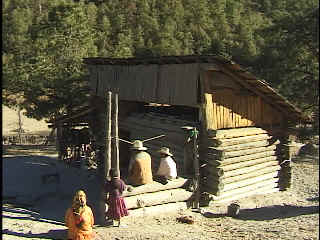
Melina's family in front of their one-bedroom cabin
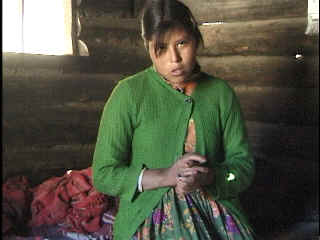
Melina in her home just after arriving

Shelter

Luck was with me and I found Pedro waiting at the bottom of the valley. As I got close, Pedro greeted me with another smile and turned away while spreading his hands. I could hear his body language speaking: "and here we are!" We were at the bottom of a wide portion of the deep gorge set back a short distance from the river. On the far side was a cornfield with remnants from the past harvest suggesting the family's food source.

Initially, I didn't recognize Pedro's home because I thought it was a storage shed. Actually, it was a rough log cabin, darkened from weather, with a hayloft above. The cabin was about 300 square feet in area and already shaded from the late afternoon sun. There were three children inside who timidly looked out the door entrance. Pedro motioned for me to go inside. A small round table and an old wood burning stove sat on a dirt floor. A single window lit Melina sitting on the family's only bed.

Telling Melina's story was important for documenting the Rotary's humanitarian efforts, but I couldn't communicate with her nor interview the family. I spent precious time making sure I had every shot I needed. There wasn't any choreography, I shot what I found, and quickly. Pedro's son brought me a cup of water. Eagerly I took it and as I raised it to my mouth, sand floated in the bottom. That water would likely result in Montezuma's revenge, but I had no choice. I needed water to survive the return ordeal.

I picked a treed area that offered some insulation against a clear night sky. I did find a large bush that offered a wind break from winds flowing down from the higher ground above. I found a fallen tree with its trunk a couple of feet off the ground. I placed my camera on a nearby rock and then stacked dead branches to form a two-sided shelter. Next, tree boughs were needed for insulation, but took way longer to break off because they were too flexible. I exhausted myself getting minimal coverage. I continued clawing pine needles into a pile for use as a blanket to cover me.

Strangely, my mind was isolated from my physical struggle and thought more about what the search party would find the next day. If I should die in the night and be covered with pine needles, a search party would never find me. Out of the darkness a flashlight flashed in my direction. Startled, I reflexed back with a yell to connect. There wasn't a reply. I pondered my choices. If I left my shelter, I would never find it again. On the other hand, if my shelter was not adequate enough to protect me, what was I really leaving?

After 100 yards, the light disappeared. Now I've lost both my shelter and my chance to be rescued. But then I heard a car horn. Maybe the search party had come with a SUV and were trying to locate me. I yelled several times while heading towards where I thought the sound came from. I found nothing nor heard anything. After heading uphill for a while, I heard a horn honking again. Upon turning around, I saw a whole line of lights along the horizon. What I perceived was the search team parking along the canyon and turning on their car lights to guide me home. I realized later that hypothermia had kept me thinking what I wanted to believe.

There really was a line of car lights, but it was street traffic in Guachochi. They were close because the canyon only separated us less than a mile. But without a flashlight, I was still stuck on this side of the canyon. We were in an open space and the stars twinkled enough to separate the sky from the land. Two large groves of trees blanked out a dark area from the horizon. Then I saw it. Through the trees was a light radiating from the house's window. It appeared warm and so inviting. I looked very closely because I didn't want to be fooled again. It really was my last salvation.

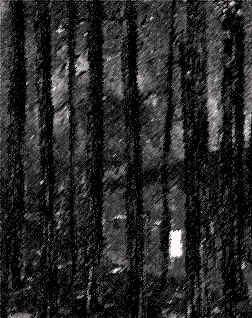
The house's window light stood out through the dark forest
What's obvious in daylight was a mystery in darkness

The Long Night

However, the approach was critical because the inhabitants wouldn't know who I was. My apprehension increased when I had to cross a barbed wire fence to reach the home. Now I was trespassing. Within a few feet after crossing the fence, I could tell I was in an idle cornfield. I brushed against dried corn stalks and each step sounded as if it had smashed hundreds of cornflakes. I was concerned that the residents would hear my thrashing through their fields and become frightened.

It was dark, but the starlight still deciphered large forms. I could see enough to know that I had to circle a wooded area in the center of the field. While going around the grove, I lost sight of the house behind the trees. I expected to find it on the other side, but didn't. As best I could tell, there was another grove of trees to be circled. I carefully continued on. As I got close to what I thought was the second grove, the dark shadow revealed itself as a house.

Obviously, my approach had alarmed the residents because the lights were out. Would they shoot first and ask questions afterwards? Carefully I approached the porch and yelled out: "Anyone home?" No answer. I walked up onto the wooden porch. With the use of my hands, I felt two doors in a recessed alcove. I knocked on one of the doors. No answer. I yelled "anyone home?" There were no sounds to be heard. Further feeling around the alcove found a crude ladder constructed out of round poles going up about 8 feet to an attic. I called out once again without a response.

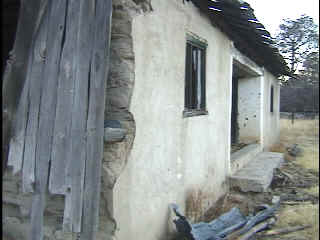
I pushed really hard on the door but it didn't open. While circulating to the right side of the house, I felt part of the house or roof had collapsed. Then around the corner I found two windows about five and a half feet off the ground. Both had been broken out. I could barely identify straw on the floor — a definite bed. Then I heard an animal moving about inside. The house's walls felt solid and most likely adobe or masonry. Its mass would surely provide a warmer shelter than the outside. At this point all I could think of was getting inside and out of the cold.

I placed my camera on the wide window sill. In my exhaustive state, I struggled to make it up into the window. I heard an animal scamper about. I finally stepped timidly onto the straw. The floor felt unstable — shaky at best. Remembering that the roof had caved in on the other side, I knew it was possible that the floor could collapse too. To be cautious, I rolled out on the straw instead of stepping onto it. I felt around and determined that there was considerable depth to the straw. I burrowed in and carefully covered myself with eight inches of straw, including my head.

There was dirt mixed with the straw and I could feel it all over me. It was in my mouth, ears, and hair. The straw beneath was excellent insulation and my back was already enjoying the warmth. It felt so good to relax and enjoy my blissful cocoon. I was already halfway to my long-awaited rest. That's when I felt something bite my foot. My leg reacted automatically with a kicking motion. I felt a small creature being thrown off. It bounded back chewing within inches of my ears. After a half-hour, I heard it scamper up what sounded like a long pipe and then it was gone.

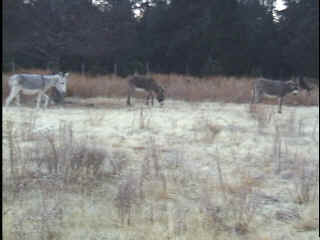
The wild burros came for a midnight snack

Dawn

Now there was finally peace and I could relax again. My mind began drifting into fantasia and then I came back to reality with the sounds of dogs barking. It must be a search team. The dogs sounded close. I really didn't want to leave my warm bed. But if I didn't, the search team may go all night looking for me. I carefully laid back the layers of straw so I could reposition them if I needed to return. An ice-cold wall of air met me. After carefully moving into the window, I jumped to the ground.

I heard search dogs barking nearby and there was another search-light. It was moving. I answered with a loud yell "here, here." No answer. The light was still moving and the dogs still barking, but nobody responded. I was aware that often a stationary light will appear to move. Actually, it's the eye's movement that creates an illusion of objects moving and that's what was happening to me. The lights were actually the tops of Guachochi's streetlights sticking above the backside of the far hill. The dogs were in Guachochi across the gorge barking from their yards, but sounded as if they were within a hundred yards.

I began to tremble and again climbed back up into the window. I slipped into my cocoon and closed the straw lid. The dirt mixed in the straw got into my eyes and it hurt. I needed water to clean my eye out. But there was none. I used a technique I learned in the Boy Scouts to remove dirt from my eye. I grabbed my upper eyelid's lashes and used them to pull the eyelid out and over the upper part of the lower lid. Then I moved my eye around in a large circle. This did the trick.

Unfortunately, the replacement of my upper straw cover wasn't as efficient as it was initially. My location was directly in front of the window with another opened on the opposite side. This location was the most susceptible to waves of cold air coming from the window and chilling my top half. I was trembling again and in danger. I needed to build another cocoon a few feet further from the wall to get out from under the window where the cold air was blowing.

The straw cover never matched up with my original bed location. However, since the outside air wasn't blowing directly on me, the overall environment was an improvement. I continually moved straw from below me to fill voids that allowed cold air to filter through. Finally, I found the rest I had been waiting so patiently for and my consciousness found a place between awake and sleep for a few brief moments.

I heard two familiar objects sliding back down the pipe. Then the two critters were chewing all around me. One worked the area around my head, the other around my feet. For an extended period of time, I expected to have my ear eaten. My thoughts blurred in and out of consciousness.

After a lapse of indeterminable time, I heard loud footsteps stomping across the front porch. Someone tried each of the doors. Then thump, and another thump from the sound of someone placing their shoulder against the door. My heart raced and beat hard. Someone was here and trying to get in. I felt fear of being discovered or being attacked. I kept quiet. Whoever this was climbed the ladder into the attic and soon became silent. Half-hour later that person came back down the ladder and walked off the porch. Within a few minutes, I heard the sound of someone puking in the front yard and then there was silence.

Meanwhile inside, my critter friends were still trying to intimidate me. Their nuisance seemed insignificant after my last visitor. They were burrowing holes in my straw bed and allowing the cold to penetrate. I continually used my hand to search my cocoon for the latest critter hole to stuff. As I'd start to doze, my body temperature would lower and then I'd start shaking again. This was a cycle that repeated itself all through the night.

I heard really heavy footsteps on the front porch. Suddenly the front door was being pounded. I could hear the sound of nails clinging for all they're worth to prevent the anchored latch from pulling out. "Screech, screech" — the door latch was about to be breached. Without concerns about an unstable floor, I flew out of my cocoon and found a table to lodge against the door. I pressed my body against the door for added insurance. I stayed still. There was silence. Whoever was there had heard me. After a half hour of silence, I got back into my straw cocoon.

It took a while for the shaking to subside, but I never really felt safe after that. Finally, I was back in my cycle of dozing and waking from body shakes. This was truly the longest night I'd ever experienced. I'm not sure how long I dozed, but eventually it began getting light. I waited a long time because I wanted the sun to warm the temperature before getting up.

Return

I decided I had waited long enough. I popped my head out of my cocoon. It wasn't morning — the light came from the moon rising. I remembered it had come up about midnight a couple of days earlier. So, my longest night had only begun. I heard something outside and I looked through the window. In the moonlight I saw burros in the yard. I thought there had been two separate intruders that night. The burros were the last.

Feeling more at ease now, I continued the rest of that night dealing with the little critters and dealing with hypothermia. Eventually the morning did come. I waited as long as I could so that the temperature wouldn't be too cold. It was about 7 AM when I decided to go, I was in perpetual motion to generate heat to offset the cold temperatures. I left — but only after getting some video of this memorable budget hotel.

In the light of dawn, I could see I had traveled right up to the last canyon. The house was a few minutes from getting back on my trail. It took me about an hour to finish the last leg through the canyon and back into town. On the way I saw search planes flying. I supposed they were still looking for me. I had to let someone know I was ok as soon as I got into town so the search could be called off.

I didn't find a ride, nor did I see any of the search team. So, I had to walk the full distance back to the hotel. I didn't know whether anyone would be there on account of the search. Then I realized I could be eating shortly. That's the first time that I had thought about breakfast. It was amazing how fast my appetite came back when I was out of danger.

As I got closer to the hotel, I could see our group inside. When I opened the door, I got quite the welcome. The first thing I did was drink several glasses of water. Then I apologized to them for having ruined their previous evening. Peg replied back: "What do you mean, we thought you were spending the night with Pedro."

Then everyone wanted to hear the whole story. When I finished, somebody asked: "It's remarkable how you found that house. How did you know it was there?" Before thinking I replied: "It was the light of course. If it weren't for the light, I wouldn't have survived the night." Until I spoke those words, I hadn't understood what a phenomenon took place. My primitive sanctuary had no lights — but I saw a window lit in the dark. The house was right where the light led me.


Reflection

The more I thought about it, the more I realized how miraculous all the interdependent events were that night. That night may appear as the night from hell, but each separate distraction actually kept me from falling asleep. My gut instinct kept me from going into the attic and guided me away from contact with one of the night's intruders. Those visitors kept my heart pounding for some time. Even the pesky rats, mischievous burros and the unknown visitors played a role in keeping my adrenaline pumping and awake. An uneventful night would have allowed me to drift off into a blissful night's sleep and never awakened.

Upon interviewing the Rotary Club volunteers, most have told me how Guachochi has changed their lives. It's more than doing good deeds; it's the "giving of oneself," making a difference, being appreciated for their effort, and at the same time building personal relationships with our Mexican neighbors.

Jack had indicated earlier I would find something special at Guachochi and he was dead on. Besides surviving, I received several other gifts. I had always wanted to see the Copper Canyon region. I had always wanted a "National Geographic" adventure. This trip combined all three into an incredible experience. This is an experience I would have never planned. But having experienced it, it's one of the best I've had.

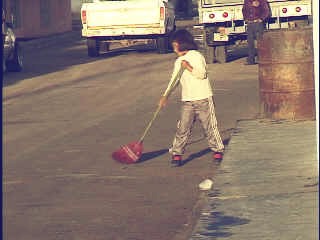
On my way back to the hotel, I saw a young girl doing her chores early in the morning

← Medical Flights to Sierra MadreAbout Kent Gunnufson »

Share this article

© 1981–2026 by Kent Gunnufson

A SnowStorm Publication